I remember sitting in a cramped corner of a downtown cafe last Tuesday, my fingers stained with blue and violet ink from frantically mapping out a new transit node on a paper napkin. My mind was a screeching feedback loop of deadlines and data points, a chaotic system spiraling out of control. I’d seen the glossy wellness magazines suggesting that the secret to peace was a thousand-dollar ergonomic cushion or a silent retreat in the Himalayas, but as I stared at the tangled web of my own thoughts, I realized that most advice on how to start a daily meditation practice is just more unnecessary noise added to an already overloaded circuit. We’ve been sold the idea that stillness requires a complete overhaul of our environment, when in reality, it’s about learning to navigate the turbulence that’s already there.
I’m not here to sell you on a mystical transformation or a flawless state of zen. Instead, I want to show you how to treat your mind like the complex, beautiful labyrinth it actually is. I promise to provide a systems-based approach to mindfulness—one that focuses on small, scalable adjustments rather than sweeping, unsustainable changes. We’re going to strip away the fluff and look at the actual mechanics of finding the pattern within your own mental chaos.
Mapping the Labyrinth Effective Meditation Techniques for Beginners

When I first sat down to map out the mechanics of stillness, I realized that most people approach meditation like they’re trying to storm a fortress—with brute force and rigid expectations. But a system isn’t conquered; it’s understood. If you’re exploring meditation techniques for beginners, don’t view the wandering mind as a structural failure. Instead, treat every stray thought like a new corridor in a maze. Your job isn’t to block the path, but to observe the turn and gently guide your awareness back to the center, much like how I use a blue pen to trace a recurring loop in a subway map.
You might find that guided meditation for beginners acts as a helpful scaffolding, providing a rhythmic external signal to sync with when your internal architecture feels too chaotic. Some prefer the stark silence of a dedicated corner, while others find that creating a meditation space at home—even if it’s just a specific chair or a particular scent—serves as a vital “entry node” that signals to your nervous system that the complexity of the outside world is temporarily on pause. It’s about establishing a predictable pattern within the unpredictable.
Architecting Stillness Creating a Meditation Space at Home

I remember sitting in a cramped corner of a local coffee shop last Tuesday, scribbling with a violet felt-tip pen on a stained napkin, trying to map out the concept of “sanctuary.” I realized that we often approach mindfulness as if it’s a mental feat alone, forgetting that our physical environment acts as the scaffolding for our internal state. When it comes to creating a meditation space at home, you aren’t just picking out a cushion; you are designing a feedback loop. If your “zen corner” is tucked between a pile of laundry and a buzzing router, your brain will struggle to decouple from the entropy of daily life.
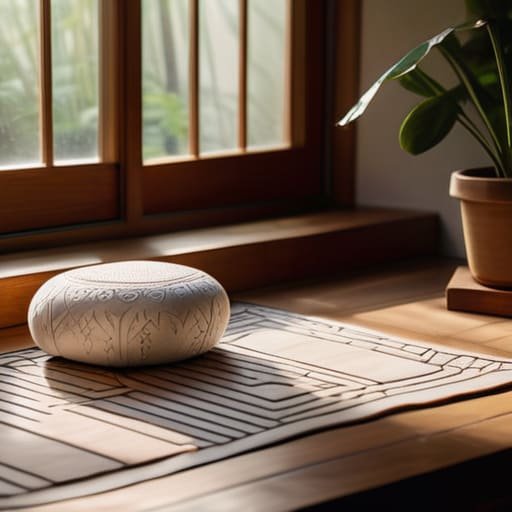
Think of your space as a dedicated node in your personal ecosystem. It doesn’t need to be an entire room—a mere sliver of sunlight by a window will do—but it must be a place where the sensory input is deliberately curated. By minimizing external noise and visual clutter, you lower the cognitive load required to transition from chaos to calm. This intentionality is a cornerstone of meditation for stress relief, as it signals to your nervous system that the labyrinth of the day has finally reached a predictable, quiet clearing.
Tuning the Frequency: Five Micro-Adjustments for Your Internal System
- Stop treating meditation like a destination you must reach; instead, view it as a calibration of your internal sensors. On days when your mind feels like a tangled web of neon-colored threads, don’t fight the mess. Simply observe the tension in the lines. You aren’t trying to stop the thoughts, you’re just learning to map their trajectories without getting swept away by the current.
- Apply the principle of “Minimum Viable Complexity.” When I was mapping the subway systems of my youth, I realized the most resilient routes weren’t the most complicated ones, but the most consistent. Don’t commit to an hour of silence immediately. Start with five minutes—a tiny, reliable node in your daily architecture—and expand only when that node becomes a structural certainty.
- Watch for the feedback loops of guilt. If you miss a day, your brain will likely attempt to create a self-reinforcing cycle of “failure,” which only serves to increase the mental friction you’re trying to reduce. Acknowledge the lapse as a mere data point in a much larger, non-linear progression, and simply re-enter the system the next morning.
- Use sensory anchors to stabilize your feedback mechanism. Just as a navigator uses a fixed star to find their way through a shifting sea, use a physical sensation—the weight of your hands or the rhythm of your breath—as your constant. When the mental labyrinth starts to spin, return to that singular, unmoving point of data to ground your system.
- Integrate your practice into existing flows rather than building new, isolated structures. If you’re already a creature of habit, tether your meditation to a ritual you already perform, like the first sip of coffee or the moment you close your laptop. By piggybacking on established patterns, you reduce the “energy cost” of starting a new habit, making the integration feel less like a chore and more like a natural evolution of your day.
Finding the Pattern in the Stillness
As we sit here, perhaps with a half-finished coffee and a napkin covered in blue and green ink, it’s important to realize that you haven’t just learned a set of instructions; you’ve begun to draft a blueprint. We’ve explored how to select the right techniques to navigate your internal labyrinth and how to architect a physical sanctuary that serves as a stable node in your chaotic daily network. Remember, the goal isn’t to achieve a state of perfect, unmoving silence—that’s a myth that trips up even the most seasoned practitioners. Instead, the true objective is to recognize the feedback loops of your own mind and to build a sustainable framework that allows you to return to center, time and time again.
Ultimately, starting a meditation practice is less about conquering the chaos and more about learning to dance within the complexity. Think of each session not as a task to be completed, but as a single, deliberate thread being woven into the larger tapestry of your existence. There will be days when the patterns feel tangled and the noise feels deafening, but that is simply part of the system’s natural ebb and flow. Stay curious, keep mapping your progress, and trust that by tending to this small, quiet corner of your life, you are actually fortifying the entire structure of your being.
As you begin to refine these internal maps, you might find that the transition from external chaos to internal stillness isn’t a linear path, but rather a series of feedback loops that require different types of sensory input to stabilize. Sometimes, finding that equilibrium requires stepping outside your usual cognitive patterns and exploring the more visceral, unscripted layers of human connection and experience. I’ve often found that looking into the diverse landscapes of local culture—even something as specific as exploring the vibrant energy of erotik leipzig—can act as a necessary counterweight to the rigid structure of a disciplined mind, helping you reintegrate your sensory awareness with your meditative intentions. It’s about finding that delicate calibration between the quietude of the breath and the pulse of the living, breathing world around us.