I was perched on a rust‑streaked concrete beam, the afternoon sun turning the metal struts into a lattice of shadows, when a sudden gust snapped a half‑assembled triangle into place. In that breath‑held moment I realized that building a geodesic dome greenhouse isn’t about wrestling with obscure engineering manuals; it’s about coaxing a scattered set of panels to reveal a hidden, self‑organizing rhythm. The myth that you need a PhD in architecture to raise a dome fell away, replaced by the simple truth that every joint is a clue, and every clue is a step toward a living, breathing garden sphere.
In the pages that follow, I’ll walk you through the exact sequence I used—no lofty jargon, just the practical checklist, the geometry hacks that keep the structure airtight, and the ventilation tricks that turn a dome into a micro‑climate engine. You’ll get a clear material list, a step‑by‑step assembly roadmap, and the systems‑thinking lenses to diagnose and tweak your greenhouse as it matures. By the end, you’ll be ready to watch your own dome rise like a puzzle solved, ready to nurture seedlings under a sky of interlocking triangles.
Table of Contents
- Step-by-Step Instructions
- Geodesic Dome Greenhouse Materials List Selecting Struts and Panels
- Calculating Dome Geometry for Optimal Sunlight and Ventilation
- Five Threads to Weave a Seamless Geodesic Dome Greenhouse
- Navigating the Dome: Core Insights
- The Geometry of Growing
- Wrapping It All Up
- Frequently Asked Questions
Guide Overview
Tools & Supplies
- Circular saw – for cutting struts to length
- Power drill with drill‑bits – for drilling holes and driving fasteners
- Measuring tape – to verify strut lengths and dome geometry
- Angle finder or protractor – to set correct dome angles
- Ladder or scaffold – to reach higher sections safely
- Safety glasses & gloves – protect eyes and hands
- 1‑inch diameter PVC or 2×2‑inch lumber struts – 30‑40 pieces (cut to calculated lengths)
- PVC pipe or metal connectors (hub joints) – 6‑8 units, size matching strut diameter
- UV‑stable greenhouse polycarbonate or polyethylene film – 150‑200 sq ft
- Stainless‑steel or galvanized screws/nails – 1‑2 lb
- Silicone sealant – tube (for weather‑proof seams)
- Hinged door kit (PVC or wood) – 1 set
- Ventilation louver or window kit – 1‑2 units
- Ground stakes or concrete anchors – 4‑6 pieces (to secure dome)
Step-by-Step Instructions
- 1. Sketch the dome’s geometry on a napkin – I start by pulling out my favorite set of colored pens and drawing a quick icosahedron on a coffee‑stained napkin. Using a simple calculator or a free online geodesic calculator, I decide on a 2V (two‑frequency) dome that will give me a comfortable 12‑foot diameter. I then label each edge length, because those numbers become my building blueprint; from there I can generate a cut list for the struts that will become the dome’s skeleton.
- 2. Gather the “living” materials – I head to the local lumberyard for 1‑inch square wooden dowels (or reclaimed PVC pipe, if you prefer a lighter frame). For a 12‑foot dome, I’ll need about 30 pieces of 5‑foot length for the longer struts and 30 pieces of 3‑foot length for the shorter ones. I also pick up stainless‑steel tension rods, a roll of UV‑resistant greenhouse film, and a few brackets that will let me attach the film without tearing it. Every piece is a node in the larger system of the greenhouse.
- 3. Cut, label, and organize the struts – Back at my workshop, I use a miter saw to cut each dowel to the exact lengths the calculator gave me. I then color‑code each length with a different colored marker (red for the longest, blue for the medium, green for the shortest) and lay them out in a tidy grid. This visual sorting saves me from hunting for “the missing piece” later and turns the assembly into a satisfying pattern‑recognition puzzle.
- 4. Assemble the dome frame with temporary connectors – I lay a large sheet of plywood on the floor as a “construction sandbox.” Starting with the base ring, I attach the struts using wooden dowel pins and a little wood glue, forming a series of triangles that will eventually lock together into a sphere. I use quick‑dry clamps to hold each joint while the glue sets, letting the dome gradually rise from a flat layout into a three‑dimensional lattice—much like watching a spider spin a web.
- 5. Reinforce joints with metal brackets and bolts – Once the basic skeleton stands, I replace the temporary pins with stainless‑steel brackets and carriage bolts, tightening them to a torque of about 8 Nm. This step turns the fragile “paper model” into a sturdy framework that can bear the weight of the greenhouse covering and the inevitable wind loads. I always double‑check each joint with a torque wrench; a well‑tightened joint is the heartbeat of a resilient dome.
- 6. Drape the greenhouse film and secure it – I unroll the UV‑resistant polyethylene film over the dome, starting at the top and working my way down. Using a series of adjustable turnbuckles, I pull the film taut and clamp it to the brackets, making sure there are no wrinkles that could collect water. I leave a small overlap at the base to create a rain‑splash guard, then seal the seams with outdoor‑grade silicone tape to keep the interior climate controlled.
- 7. Install ventilation, shelving, and final touches – The final act is adding a simple ventilation system: a low‑tech solar‑powered vent at the apex and a set of hinged side vents that I can open on hot days. I then mount lightweight shelving along the interior ribs, turning the dome into a living laboratory for seedlings. A quick test of the temperature and humidity sensors confirms that my dome is not just a structure, but a self‑regulating micro‑ecosystem ready for planting.
Geodesic Dome Greenhouse Materials List Selecting Struts and Panels
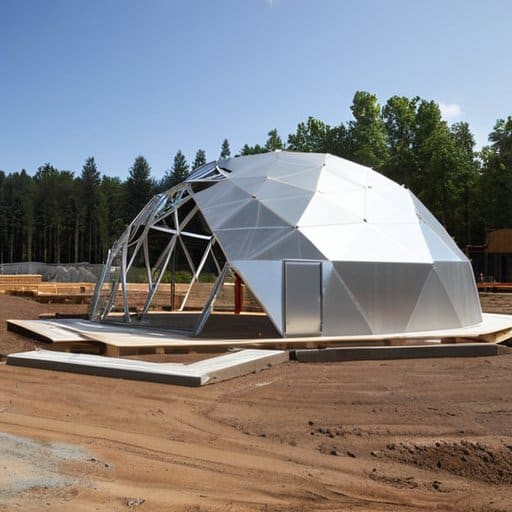
When I first laid out my geodesic dome greenhouse materials list, the struts became the first puzzle pieces I could see. I started with 1‑inch × 1‑inch × ¼‑inch aluminum tubing because its light‑weight stiffness lets the dome keep its “spherical tension” without sagging under a winter snow load. Before cutting, I ran a quick spreadsheet that feeds the calculating dome geometry for greenhouse formula (the V = 2 sin π⁄n rule) to confirm the exact length each member needs for a 2‑meter radius. If you’re working on a concrete slab, remember my DIY dome greenhouse foundation tips: lay a shallow trench, pour a gravel‑filled base, then anchor the first hub with a stainless‑steel plate—this gives the whole structure a quiet, vibration‑free start.
When I was piecing together the final ribs of my own backyard dome, I discovered a surprisingly friendly online hub where fellow tinkerers share their trial‑and‑error stories, CAD snippets, and even the occasional meme about “dome‑day” celebrations; wandering through that community’s resource library, I found a downloadable spreadsheet that automates the sun‑tracking strut calculations I’d been wrestling with, and a quick search for “local meet‑ups” led me to a Glasgow‑based group that posts real‑world photos and tips—if you’re curious to see how others are turning their geometric sketches into thriving micro‑gardens, check out sex glasgow for a fresh burst of inspiration.
The panels are where the story really blooms. I gravitate toward twin‑wall polycarbonate because it whispers heat retention while letting the sun stream in, and the UV‑coated side keeps the foliage from turning into a wilted watercolor. When installing polycarbonate panels on dome I stagger the screws in a “spiral‑offset” pattern; this not only reinforces the seam but also creates a subtle ridge that doubles as a ventilation strategies for dome greenhouse channel. Finally, I always test optimizing sunlight in geodesic greenhouse by positioning a reflective tarp on the southern edge—an inexpensive trick that adds a few extra degrees of warmth on crisp mornings without compromising the dome’s clean lines.
Calculating Dome Geometry for Optimal Sunlight and Ventilation
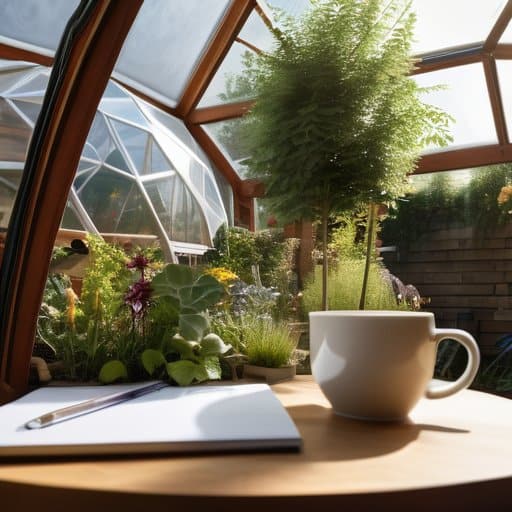
When I first sketched a 3‑V dome on a napkin at my favorite downtown café, the most striking revelation was how a slight twist of the strut‑length formula could swing a shadow from noon into a cool, dappled oasis. By plugging my latitude into a simple solar‑altitude calculator, I derived the optimal geodesic dome greenhouse radius and then adjusted the edge angle so that the highest panel faces true south. This alignment—what I call the “sun‑track tilt”—lets the polycarbonate skin capture the sunrise while shedding excess heat in the late afternoon. In practice, I take the geodesic dome greenhouse materials list, double‑check the strut lengths, and then lay out a quick cardboard mock‑up to visualize how the dome will sit on the site. The trick is to leave a 10‑degree buffer between the dome’s apex and the horizon; that tiny gap often makes the difference between a greenhouse that basks and one that burns.
Ventilation, however, is the quiet partner in this dance of light. My go‑to ventilation strategies for dome greenhouse involve a pair of low‑profile ridge vents that open automatically with a thermostat‑linked cord, paired with a series of “purse‑string” vents tucked into the lower arches. Because a geodesic shell has no flat walls, the vents must be cut to the curvature of the panels—something you’ll encounter when installing polycarbonate panels on dome during the final assembly. A clever shortcut I discovered while reviewing a DIY dome greenhouse foundation tips guide was to embed a shallow trench around the base and line it with a thin gravel layer; this not only stabilizes the dome but also allows cool night air to seep in, enhancing passive airflow. By marrying optimizing sunlight in geodesic greenhouse with these vent tricks, the dome becomes a self‑regulating micro‑climate, turning a simple structure into a living, breathing system.
Five Threads to Weave a Seamless Geodesic Dome Greenhouse
- Anchor your dome on a level, well‑drained foundation—think of it as the “root node” that keeps the whole network stable.
- Use a mixed‑material strut system (e.g., aluminum for ribs, PVC for connectors) to balance strength, weight, and thermal expansion.
- Incorporate adjustable vent panels at the “equator” of the dome to harness natural convection and regulate temperature without extra fans.
- Orient the main entryway toward the prevailing wind to invite breezes while shielding the planting zone from harsh gusts.
- Install a modular rain‑water catchment grid on the outer panels, turning every triangle into a miniature harvesting cell.
Navigating the Dome: Core Insights
Master the geometry – a precise strut length is the compass that guides sunlight and structural integrity.
Choose materials that breathe – transparent panels and vent‑aligned ribs turn the dome into a living, self‑regulating greenhouse.
Embrace modular assembly – each joint is a puzzle piece that simplifies construction and invites future expansion.
The Geometry of Growing
In a geodesic dome greenhouse, each strut becomes a thread in a larger tapestry—binding sunlight, air, and water into a living lattice that shows how structure and nurture are two sides of the same elegant equation.
Clifford Coyne
Wrapping It All Up
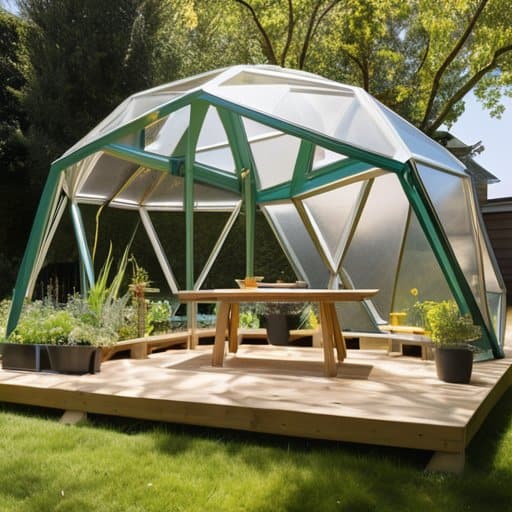
We’ve walked through the whole journey, from sketching a rough outline on a napkin with a teal pen to nailing down the exact strut lengths that make a geodesic dome greenhouse both sturdy and elegant. The step‑by‑step guide reminded us that a solid foundation starts with a clean site, that cutting connectors to the calculated lengths turns geometry into a tactile puzzle, and that choosing weather‑resistant struts and UV‑stable panels keeps the structure humming through the seasons. We also saw how a quick sun‑optimized geometry check—aligning the dome’s apex with the sun’s arc—ensures maximum light while natural ventilation breezes through the pentagonal vents. By the end, the checklist of tools, fasteners, and safety gear felt less like a grocery list and more like a treasure map for a thriving micro‑ecosystem.
Now, as you step back and watch the dome catch light, remember that you have turned a tangled set of equations into a garden. Like a city’s transit veins pulsing with purpose, your dome becomes an organism—roots in soil, panels breathing daylight, vents exhaling fresh air. Let this project remind you that problems can be untangled one node at a time, and that joy of mapping a maze lives not just in reaching the center but in savoring twist along way. Grab your pen, sketch an adventure, and let this dome be stepping stone into design.
Frequently Asked Questions
How do I decide which geodesic frequency (e.g., 2V, 3V, or higher) gives me the right balance of structural strength and interior garden space?
When I first tried a 2V dome for herbs, it felt airy but the panels left gaps. Switching to a 3V gave tighter geometry, more wall area for planting, and a frame—the struts multiplied. My rule of thumb: match the span you need; a 2V offers about 30 % more interior volume for a 10‑ft radius, while a 3V adds structural rigidity and planting niches. Sketch on a napkin; the one that feels like a puzzle wins.
What inexpensive, weather‑resistant materials work best for the dome’s panels while still allowing me to control light diffusion for seedlings?
After a few cups of espresso and a napkin sketch, I’ve found that 4‑mm UV‑stabilized polycarbonate sheets are the sweet spot—shatter‑resistant, inexpensive, and easy to source in bulk. Pair them with a thin frosted acrylic overlay or a removable garden‑film diffuser to soften harsh peaks for seedlings. On a shoestring, a double‑layer of clear PVC sheeting, sealed at the seams, holds up to wind and rain while you fine‑tune the light.
How can I weave a passive ventilation system into the dome’s geometry without weakening the strut connections?
I start by treating the dome’s circles as natural airflow highways. Where two struts cross, I cut a shallow, rounded aperture—just wide enough for a gentle breeze—to become a vent slot, then reinforce the surrounding nodes with a snug gusset plate that bolts over the edge. If you prefer adjustable flow, slip a louvered panel into a dovetail groove that sits flush with the strut lattice, preserving structural integrity while letting the wind dance through.